How to Choose a Sleeping Bag/Quilt: A Buyer's Guide
At a glance: To choose the right sleeping bag or quilt, match the temperature rating to the lowest temperature you expect minus 10 to 15°F, pick down for dry cold or synthetic for damp or budget trips, and choose a shape that fits how you sleep. Pair it with a sleeping pad whose R-value matches the season. A quilt often delivers the same warmth at 30 to 50% less weight than a comparable sleeping bag.
Sleeping bag specs can overwhelm: temperature rating, fill power, draft tube, draft collar, mummy versus rectangular. Six factors decide whether you sleep warm or shiver. This guide covers each one, plus a decision checklist and one alternative most buyers overlook.
Start With How You'll Use It
The first decision: what kind of trip, and how often will you camp?
Match your bag to your trip type
- Car camping: comfort and room beat pack weight. A roomy rectangular sleeping bag works.
- Backpacking and long-distance hiking: every ounce in your pack counts. A mummy sleeping bag or quilt fits best.
- Winter and high-altitude trips: warmth-to-weight ratio matters most. Down insulation or a quilt.
How often do you camp?
- Casual summer car camper: no need for a premium down sleeping bag or quilt.
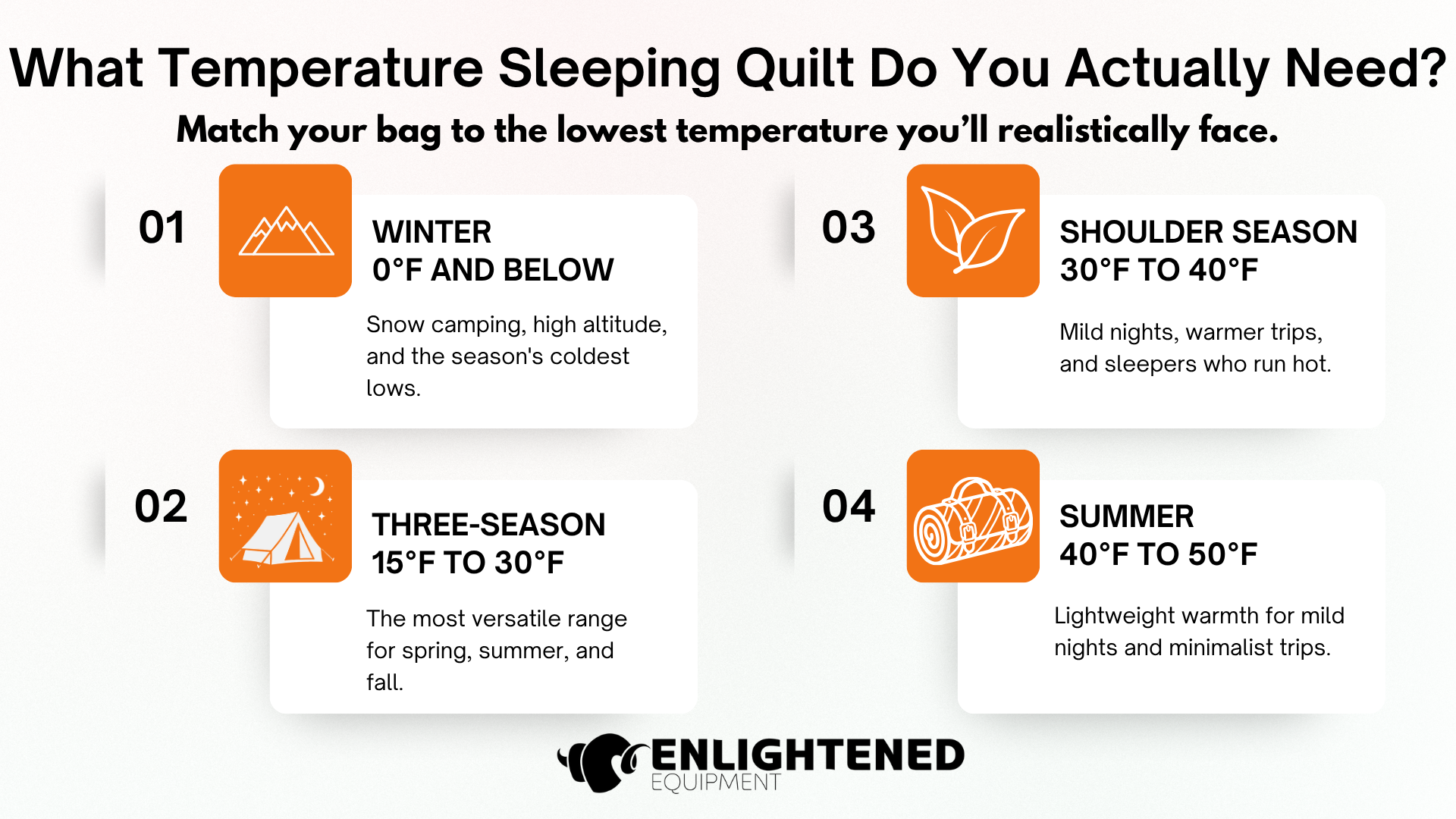
- Weekend backpacker: needs versatility. A 20°F rating handles most three-season use.
- Thru-hiker: needs the lightest, most packable option that meets the lowest temperature expected.
The right sleeping bag or quilt for your trip starts here.
Match the Temperature Rating to Your Trip
Most sleeping bags use the ISO 23537 standard that replaced EN 13537. A heated manikin in a cold chamber produces three numbers.
The three ratings explained
- Comfort rating: the lowest temperature at which an average woman can sleep on her back without feeling cold.
- Lower limit rating: the lowest temperature at which an average man can sleep curled up without waking.
- Extreme rating: a survival number, not a use temperature.
The 10 to 15°F buffer rule
Take the minimum temperature you expect, then subtract 10 to 15°F. That buffer covers shifting forecasts, wind, and tired arrivals at camp.
A cold sleeper should use the comfort rating; a warm sleeper can use the lower limit. Most bags are sold as unisex bags; women's-specific models add insulation and run a few degrees warmer. See our Temperature Rating 101 guide for more.
Your Rating is Only As Good As Your Sleep System
The ISO test assumes a specific setup: the manikin sleeps on an insulated pad with an R-value of at least 5.38, wears a base layer, and uses a hat. If your setup doesn't match, the rating won't hold up.
Your sleeping pad matters more than most realize. A thin pad allows heat loss into the ground and can drop a bag's effective rating by 10 degrees or more. The gap matters most for winter camping, where the pad does as much work as the bag.
Match your pad R-value to the season
- Summer: R-2 to R-3
- Three-season: R-4 or higher
- Winter: R-5 or higher
A sleeping bag liner adds 5 to 15°F of extra insulation on the coldest nights, or works alone in warmer conditions. Browse our sleeping pad lineup for the right sleeping pad.
Down vs. Synthetic Insulation
The biggest insulation type choice is down or synthetic. A down sleeping bag has the best warmth-to-weight ratio; synthetic fill trades efficiency for wet-weather performance. Comparison at the same temperature rating:
|
Down |
Synthetic |
|
|
Warmth-to-weight |
Best available |
Heavier for the same rating |
|
Packed size |
Smallest |
Bulkier |
|
Wet performance |
Loses loft when wet |
Keeps insulating, dries faster |
|
Cost |
Higher upfront |
Lower |
|
Lifespan |
Decades with proper care |
Shorter |
|
Best for |
Dry, cold trips |
Humid, rainy, paddling, or budget |
The simple rule: dry, cold trips reward down. Wet, humid, or budget trips reward synthetic.
A synthetic sleeping bag or quilt is the pick for humid climates, rainy trips, or paddling adventures where dry insulation isn't guaranteed. Its lower cost makes a synthetic bag a strong entry point for new campers.
Match the Shape and Fit to How You Sleep
Shape affects warmth, weight, and comfort all at once.
|
Shape |
Warmth and weight |
Best for |
|
Mummy |
Warmest, lightest |
Cold trips, weight-conscious backpackers |
|
Semi-rectangular / spoon |
The middle ground |
Side sleepers who want some room |
|
Rectangular |
Most rooms, least efficient |
Warm-weather car camping |
A mummy bag tapers from shoulders to feet, saving weight by trimming dead air space. Narrow mummy bags can feel restrictive to side sleepers. A rectangular sleeping bag offers the most room but costs warmth and weight: the extra space needs more body heat to stay warm, which works for warm weather car camping but is inefficient on cold trips. Semi-rectangular and spoon shapes split the difference.
A quilt sidesteps shape entirely: it drapes over you and pairs with your pad rather than wrapping around.
Getting the fit right
- Too loose creates cold pockets the body has to heat.
- Too tight compression of the insulation creates cold spots.
- Maximum user height is listed by most manufacturers; check that yours fits with a few inches to spare.
Weight, Packability, & Features
Backpackers obsess over pack weight; car campers don't. Compare options at the same temperature rating: two bags built for different temperatures aren't fair matches no matter what the scale says.
Down packs smaller than synthetic for the same warmth. A compression sack or stuff sack helps either pack down; both should be stored uncompressed at home to protect loft.
Features worth the weight
- Draft collar: seals warmth around your neck.
- Draft tube: runs along the zipper to block cold air.
- Snug hood: adds extra warmth on cold nights.
- Well-shaped footbox: doesn't compress around your feet.
Skip features you won't use.
Consider a Quilt Instead
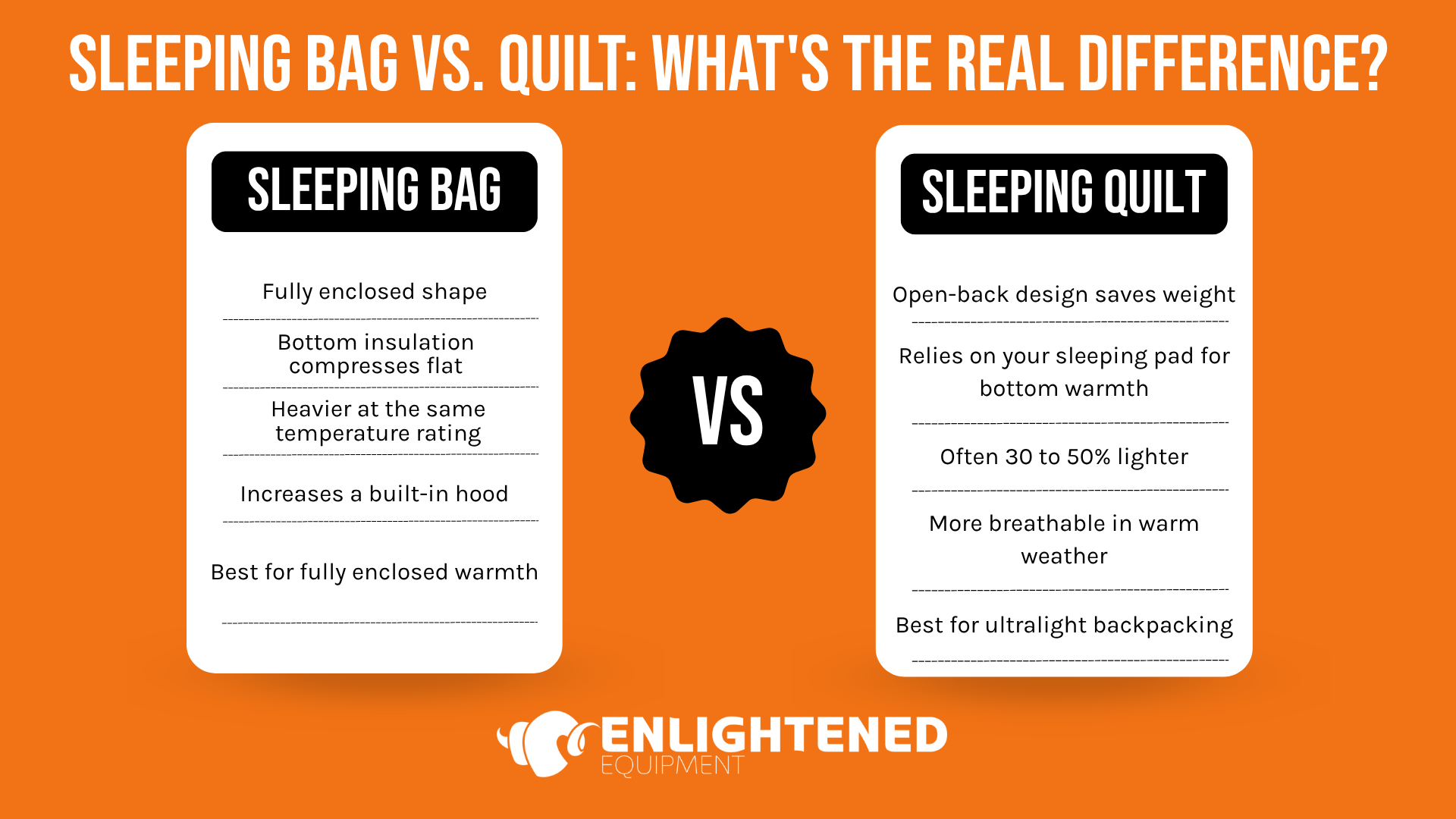
Most sleeping bag conversations skip this: the bottom insulation in a sleeping bag does almost nothing. Body weight compresses it flat, leaving thin material between you and your pad. You're paying for insulation that isn't keeping you warm.
A backpacking quilt removes that wasted material. The result is a lighter sleep system that hits the same temperature rating at 30 to 50% less weight than a comparable down or synthetic sleeping bag. Quilts pair with your sleeping pad for bottom warmth, which the ISO standard already assumes.
EE quilts carry lower limit ratings verified through independent lab testing at Kansas State University's Institute for Environmental Research. Learn more about quilts to see the math.
Putting It All Together
Choosing the perfect sleeping bag or quilt comes down to five questions:
- What kind of camping will you do most?
- What is the lowest temperature you'll realistically face? Subtract 10 to 15°F for a buffer.
- Down or synthetic fill? Dry and cold trips lean down; damp or budget trips lean synthetic.
- Mummy, rectangular, or somewhere in between?
- Sleeping bag or quilt?
The bottom line: match your rating to your trip, build a complete sleep system with the right pad, and you'll get a comfortable night's sleep.
Ready to build your setup? Browse our quilts by temperature:
- Summer: 50°F and 40°F
- Three-season: 30°F and 20°F
- Winter: 10°F and 0°F
Pair your quilt with the right sleeping pad for a complete sleep system.
Frequently Asked Questions
What temperature sleeping bag or quilt should I get?
Match the rating to the lowest temperature you expect on your coldest realistic trip, then subtract 10 to 15°F for a buffer. A 20°F rating is the most versatile choice for three-season use in most of the United States.
What is the difference between a comfort rating and a lower limit rating?
The comfort rating is the lowest temperature at which an average woman can sleep on her back without feeling cold. The lower limit rating is the lowest temperature at which an average man can sleep curled up without waking. Cold sleepers should use the comfort number; warm sleepers can use the lower limit.
Down or synthetic for a beginner?
For new campers in mild climates, synthetic is more forgiving: lower cost, better performance in damp conditions, easier to care for. Down is the better long-term investment for serious backpackers in dry, cold conditions.
Are quilts warmer than sleeping bags?
At the same temperature rating, a quilt delivers comparable warmth at less weight, since the compressed bottom insulation of a sleeping bag adds little practical warmth. Your sleeping pad's R-value carries the bottom insulation in either system.
Can I use a sleeping bag liner instead of buying a warmer bag?
A liner adds 5 to 15°F of warmth for occasional cold trips or works alone in warmer conditions. For regular use in cold conditions, a properly rated sleeping bag or quilt is the more reliable choice.