How to Pack a Backpack: A Zone-by-Zone Guide
At a glance: The best way to pack a backpacking pack is by zones. Bulky, light items like your sleeping bag or backpacking quilt go at the bottom. Heavy, dense items like food and water sit in the middle close to your back. Bulky essentials you'll need on the trail go at the top, and small, frequently used items go in external pockets and hip belt pockets. Keep heavier items centered between your shoulder blades to stabilize your center of gravity, and aim for a total pack weight under 20% of your body weight for the most comfortable hike.
How do I organize a backpacking pack?
Every backpacking pack has four main packing zones, and each zone is best suited for specific gear. Using them correctly balances your pack, keeps your center of gravity stable, and gives you easy access to what you need most on the trail.
What are the packing zones of a backpack?
A backpacking pack has four zones: the bottom (bulky, light gear), the core or main compartment (dense, heavier items), the top (bulky essentials for on-trail use), and external storage (hip belt pockets, side pockets, and the top lid). Learning this system is the foundation of efficient packing.
Why does backpack weight distribution matter?
Proper backpack weight distribution keeps your center of gravity aligned with your body's, which reduces strain on your shoulders and lower back. When heavy items sit too low or too far from your spine, they create a pendulum effect that pulls you backward and forces you to overcorrect with every step. A well-distributed load lets your hips and leg muscles carry the weight instead of your shoulders.
What goes in each backpacking pack zone?
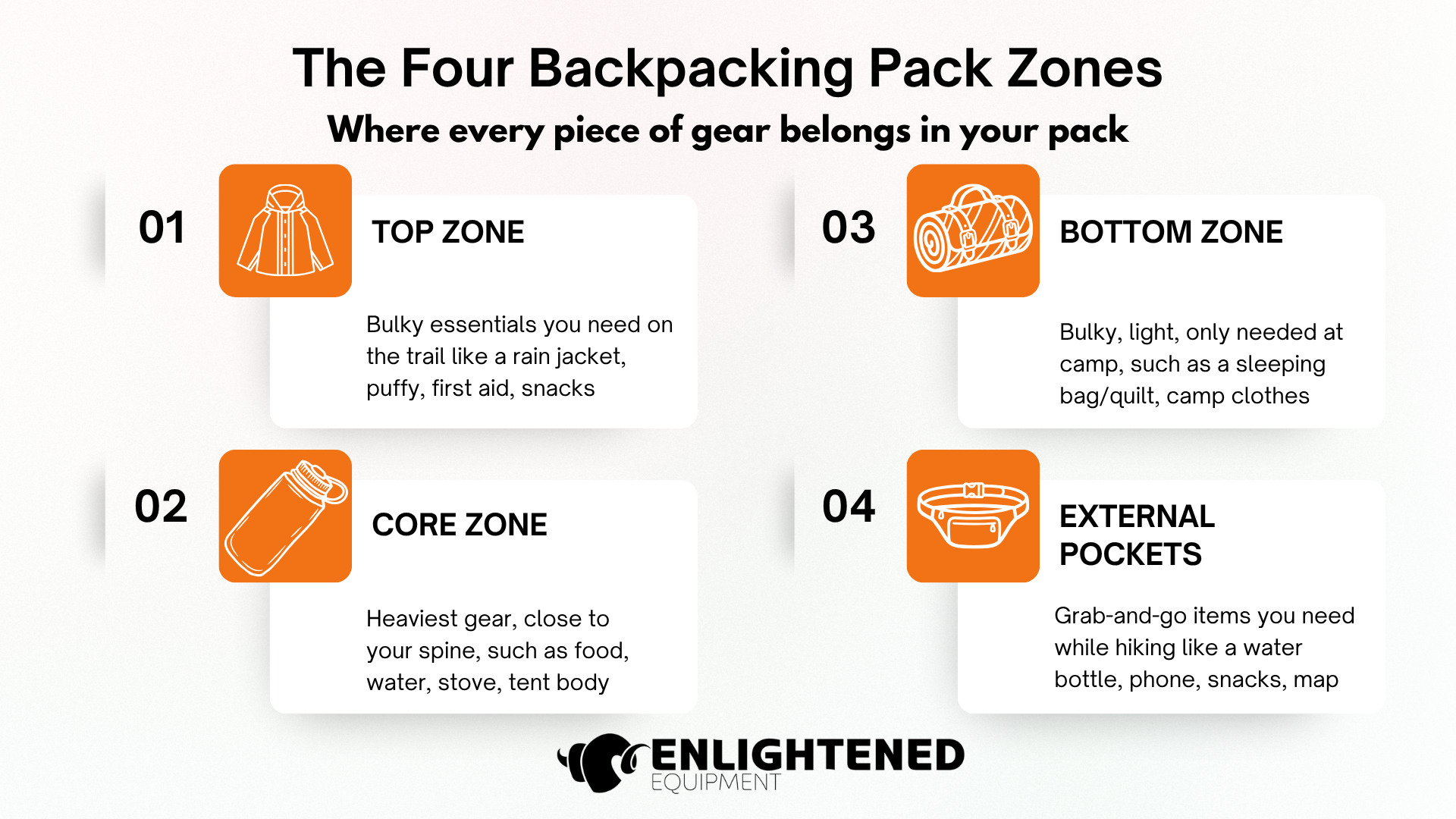
Here's what belongs in each zone, from bottom to top.
What goes in the bottom of a backpacking pack?
The bottom of your pack is for bulky, lightweight items you won't need until camp. This includes your sleeping bag or ultralight backpacking quilt in a compression sack, camp-only clothes like a puffy jacket, and sometimes your sleeping pad if it fits inside. These items create a stable foundation without dragging your center of gravity too low.
What goes in the core zone of a backpacking pack?
The core zone (the main compartment closest to your back) is for your heaviest and densest gear. Pack your food, hydration reservoir or water bottle, stove and fuel canister, cook pot, bear canister if required, and tent body here. Position these items between your shoulder blades and pressed against the internal frame to keep the load stable and close to your spine.
What goes in the top of a backpacking pack?
The top of your main compartment holds bulky essentials you might need during the day. Pack your rain jacket or rain gear, a warm insulated puffy jacket, a first-aid kit, day snacks, and toilet paper here. These are items you can reach quickly at a rest stop without unloading your whole pack.
What goes in external pockets and hip belt pockets?
External storage is for anything you need at grab-and-go speed. Water bottles go in side mesh pockets, and trekking poles slide into external loops when not in use. Your top lid (or "brain") holds a headlamp, sunscreen, map, and small daily items. Hip belt pockets are perfect for your phone, snacks, lip balm, and anything else you'll reach for while hiking.
Backpacking pack zone reference table
|
Zone |
What goes here |
Why |
|
Bottom |
Sleeping bag or backpacking quilt, sleeping pad, camp clothes |
Bulky, light, only needed at camp |
|
Core |
Food, water, stove, fuel canister, tent body, bear canister |
Dense and heavy, closest to the spine |
|
Top |
Rain jacket, puffy jacket, first aid kit, day snacks |
Bulky essentials for on-trail use |
|
Hip belt pockets |
Phone, snacks, lip balm, sunscreen |
Frequently accessed while hiking |
|
External pockets |
Water bottles, trekking poles, tent poles |
Easy access without opening the pack |
|
Top lid |
Headlamp, map, sunscreen, small items |
Quick access at rest stops |
How do I distribute weight in a backpacking pack?
Weight distribution is about balancing your load side to side and keeping heavy items in the sweet spot for your center of gravity.
Where should heavy items go in a backpacking pack?
Heavier items should sit in the middle of your pack, close to your spine, at about shoulder-blade height. Packing heavy items too low drops your center of gravity and forces you to lean forward. Packing them too high makes you top-heavy on uneven terrain. The sweet spot is centered vertically and pressed close to your back, according to the American Hiking Society's packing guide.
How much should a backpacking pack weigh?
A loaded backpacking pack should weigh no more than 20% of your body weight for the average backpacker. Ultralight backpackers often target a base weight under 10 pounds and a total pack weight closer to 15% of body weight. Lightweight backpacking gear like an ultralight backpacking quilt, a compact sleeping pad, and a minimal sleep system are the fastest ways to bring total pack weight down.
How do I put on a packed backpacking pack?
Even a well-packed pack becomes uncomfortable if you don't put it on and adjust it correctly.
How do I lift a heavy backpacking pack correctly?
To lift a heavy backpack, loosen all straps, grab the haul loop at the top of the back panel, lift the pack to your thigh, then slip one arm through a shoulder strap and swing it onto your back. Never lift by a shoulder strap alone. This technique protects your pack and prevents shoulder strain.
How should a packed backpack fit on my body?
Your hip belt should sit on your hips (on the top of your hip bones, not around your waist), carrying most of the pack's weight. Shoulder straps should wrap snugly without carrying significant load. Load lifters at the top of your shoulder straps should sit at a 30 to 60 degree angle. Your sternum strap should be loose enough that you can breathe comfortably.
Common Backpacking Pack Mistakes to Avoid
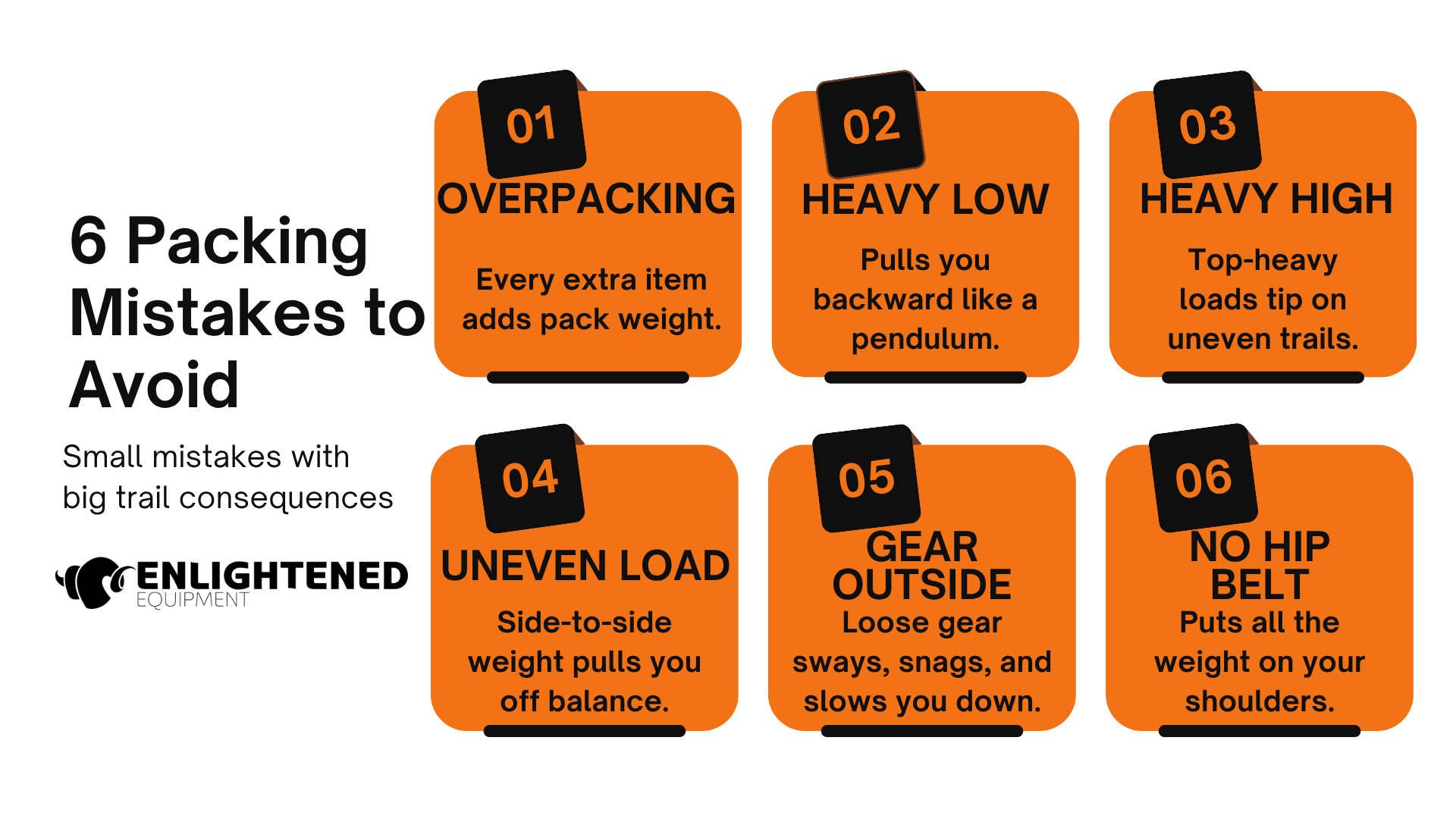
Even experienced backpackers make these mistakes. Learning to spot them will save your back on longer trips.
- Overpacking "just in case" items: Every item adds pack weight. Stick to your packing list and backpacking checklist.
- Heavy items too low: Creates a pendulum effect that pulls you backward.
- Heavy items too high: Makes you top-heavy on uneven trails.
- Uneven side-to-side weight: Pulls you to one side with every step.
- Hanging gear outside the pack: Sways and snags on branches.
- Skipping the hip belt: Puts all the weight on your shoulders instead of your hips.
- Water bottles in the top lid: Places the heaviest single item at the top, ruining your balance.
- Forgetting to waterproof: A single storm can soak your sleep system.
Build a Lighter, Smarter Sleep System
Your sleep system is one of the biggest opportunities to cut pack weight without giving up warmth or comfort. A backpacking quilt weighs less than a comparable sleeping bag at the same temperature rating and packs down smaller in your pack's bottom zone. At Enlightened Equipment, our quilts are handmade in the USA and independently temperature-tested for accurate performance. Browse our down quilts by temperature to build a lighter sleep system, and pair it with the right sleeping pad for the season.
Frequently Asked Questions
Should I use a pack liner or a pack cover for rain?
A waterproof backpack liner (or a heavy-duty trash compactor bag) inside your pack is more reliable than an external cover in heavy rain. Pack covers work for light showers but can slip in wind or leave the top of your pack exposed. Using a dry bag or liner keeps your sleep system dry no matter what.
Should I use stuff sacks for my backpacking gear?
Use a compression sack for your sleeping bag or backpacking quilt to save space in the bottom zone. Beyond that, extra stuff sacks add weight and make it harder to fill empty space in your pack. Loose clothing works well as filler to keep gear from shifting.
Where should my quilt or sleeping bag go in a backpacking pack?
Your sleeping bag or sleeping quilt for backpacking belongs at the bottom of your pack in a compression stuff sack. It's bulky but light, which makes it a stable base for the rest of your load. A backpacking quilt saves space and weight over a comparable sleeping bag.
How do I pack a backpacking pack for a multi-day trip?
The same four-zone system applies for longer trips and any multi-day backpacking trip. The main change is more food and possibly more fuel in the core zone. Repack each morning using the same layout so gear stays organized and easy to find.
How do I store food in a backpacking pack?
Food goes in the core zone, either in a food bag or a bear canister if required by the area you're hiking. Keep food away from your sleeping bag or quilt and separated from strong-smelling items. Follow local guidelines for backpacking food storage overnight.